

Dec 4, 2025
Whitney + Drew from Rhubarb
We've spent this year living in two worlds at once: the world of runaway generic AI (OpenAI etc.) promising to handle everything, and the world of real garden, messy, local, seasonal, intimate, often fragile.
The more we've dug into it, the more obvious it's become: Gardening doesn't need general intelligence. It needs specialized, garden-native wisdom. Wisdom that is both from humans to human communication and if 'desired' expanded with specialized AI insights and empathy.
And something else became clear: the real opportunity isn't just better answers. It's finally being able to see inside gardens when things go right, and when they go wrong.
Click here If you missed the original Rhubarb Whitepaper
What everyone else is missing
Every gardening company is getting sold the same solution: feed your content into a large language model and call it innovation.
That's not what gardening needs.
Gardening needs to reduce failure. Roughly half of new food gardeners quit after their first season. Not because they don't care but because things go wrong mysteriously and they can't figure out why. That's not an information problem. That's a visibility problem.
Gardening needs to be contextual. Not theoretical advice from a bottomless pit AI LLM, but guidance based on what's actually happening in your specific bed, your soil, your timeline, your challenges.
Gardening needs to be social. The neighbor who grew your same tomatoes last year and knows exactly what you're facing. The local expert who understands your microclimate. The garden center that can actually see what you're growing before you walk in asking for help. The product that shows up when its needed, not as a random ad in a feed.
You can't help someone if you can't see what they're experiencing.
What we actually built
Rhubarb isn't a chatbot. It's a platform where gardens become visible.
Gardeners track what they're actually doing. Photos, notes, observations, struggles, wins. Not aspirationally; really. The garden becomes a living record.
Ruby knows your garden. Not gardens in general. Yours. Your conditions, your timeline, your history. She learns from what you share and understands your specific context.
Community happens locally. Ruby connects you to the people and expertise that matter for your situation. The person battling your same pest. The expert who knows your zone. The business that can finally see what you need instead of guessing.
Commerce becomes contextual. When a garden center can see that your tomatoes are struggling in week three, they can offer help that's timely and relevant. That's not selling, that's supporting. And it creates loyalty that transactions never will.
This is what changes everything: first-party behavioral data from inside gardens that's never existed before.
Not just purchase data. Not just search queries. Actual growing behavior that reveals what leads to success versus what makes people quit.
That's ROI. Real, measurable impact on the thing that matters most: keeping gardeners gardening.
Gardens that talk back
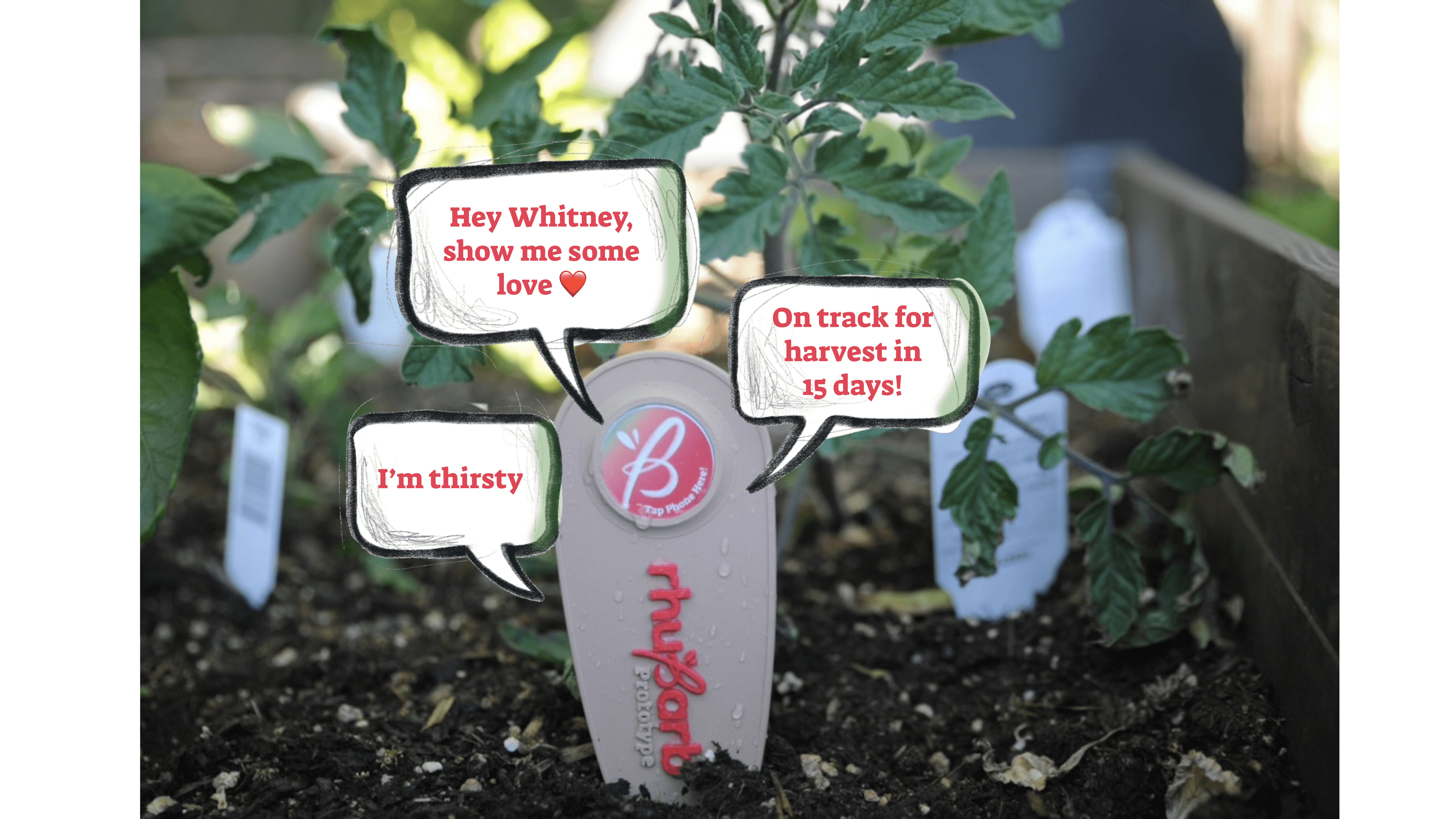
We built smart garden tags that gardeners love. Tap one with your phone and you're instantly tracking that plant. Quick. Frictionless. The garden becomes connected without feeling surveilled.
But Year 2 is where it gets interesting.
We're making gardens that engage you based on what's actually happening, or what's not happening when it needs to.
Walk past your tomatoes and your phone buzzes: "Hey Joe, you haven't watered me in a week. Show me some love."
Not generic reminders. Specific alerts based on what Ruby knows about your garden, your climate, recent weather, what you've been doing, what needs to happen next.
The garden itself becomes the interface. Not pulling you to a screen. Pushing you back to the soil.
This is what specialized AI makes possible. Not broad competence across everything. Deep understanding of one thing: what your garden needs right now, and how to help you give it.
Why this matters differently
Generic AI optimizes for engagement. Time in app. Attention captured (sound familiar - social media?)
We optimize for outcomes. Gardens tended. Failures prevented. Harvests celebrated. Growers who come back next season.
Generic AI wants to scale infinitely across every domain.
We want to go infinitely deep into one: understanding what actually makes gardens and gardeners thrive.
Generic AI treats people as users generating data.
We treat growers as the experts of their own space, and build intelligence that amplifies their knowledge and connects them to others who can help.
This isn't just philosophy. It's practical. It's the difference between a chatbot that suggests fertilizer when your plants are overwatered, and a system that knows your soil stays wet because you're in a low spot and suggests raised beds instead.
Context is everything. And context only exists when you can see inside the garden.
What we're building toward
Three years in. Thousands of gardeners sharing and testing. A platform that's live and working. Smart tags that gardeners test and love. Data that's never existed before.
Proof that specialized intelligence serving one thing well beats generic intelligence trying to do everything.
Year 2 is about gardens that talk. Intelligence that knows when to speak up and when to stay quiet. Technology that pushes attention back where it belongs: into the soil, into the relationships, into the satisfaction of growing something that lives.
We don't know if that's enough in a world that often rewards the opposite approach. But we're hell-bent on finding out.
Because the garden is calling. And every person who keeps growing instead of quitting, every business that builds on relationships + transactions, every neighbor who helps another, every harvest celebrated instead of mourned, these are victories worth pursuing.
This is Rhubarb. Not another chatbot. A different path entirely.